Progesterone and the Thyroid
When we experience symptoms such as fatigue, hair loss, mood changes, or unexplained weight changes, the first step is usually checking TSH and thyroid hormone levels. However, it often happens that these results are “within the normal range,” yet the person still does not feel well.
The missing piece of the puzzle is often progesterone and its complex relationship with other hormones.
Why Is Progesterone Important for Thyroid Function?
Progesterone is not only a hormone that supports pregnancy; it also acts as an important “assistant” to thyroid function in several key processes.
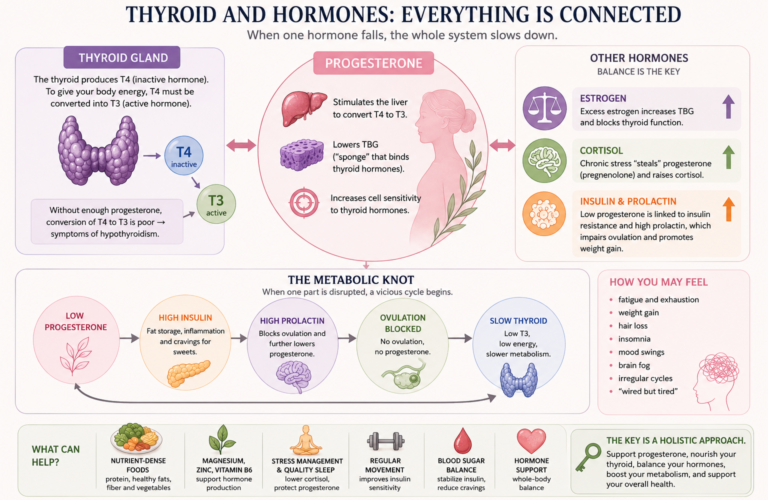
Supporting the liver: helping convert T4 into T3
The thyroid gland mainly produces T4 (the inactive form of thyroid hormone). In order for the body to use it efficiently and produce energy, T4 needs to be converted into T3 (the active form).
A significant part of this conversion takes place in the liver, and progesterone supports healthy liver function and hormone metabolism. When progesterone levels are insufficient, T4 conversion may become less efficient, and some people may experience symptoms associated with low thyroid function even when standard thyroid tests appear normal.
Progesterone and TBG (thyroxine-binding globulin)
Progesterone may influence the level of thyroxine-binding globulin (TBG), a protein that transports thyroid hormones in the bloodstream.
Think of TBG as a transport system for thyroid hormones. If there is too much TBG, more thyroid hormones may remain bound and less may be immediately available as free hormones that can enter cells.
The balance between bound and free thyroid hormones is an important part of how the body regulates metabolism.
Improving cellular sensitivity to thyroid hormones
Progesterone also plays a role in how cells respond to hormones. Proper hormone balance helps ensure that thyroid hormones can effectively communicate with tissues and support metabolism.
Symptoms of Progesterone Imbalance Throughout a Woman’s Life
Progesterone imbalance does not look the same in a woman in her twenties and a woman approaching menopause.
| Life stage | Common symptoms associated with low progesterone |
|---|---|
| Reproductive years (20–35) | Strong PMS, tender or swollen breasts, jawline acne, irregular cycles, anxiety |
| Perimenopause (35–50) | Sleep disturbances (especially waking around 3–4 AM), night sweats, sudden mood changes, water retention, brain fog |
| Menopause | Changes in bone density, dry skin and mucous membranes, lower libido, slower metabolism |
The Hormonal Triangle: Progesterone, Estrogen, and Cortisol
No hormone works alone. Hormones constantly interact with each other.
Progesterone vs. Estrogen (The Balance)
Thyroid health is influenced by the balance between progesterone and estrogen.
When progesterone decreases, estrogen may become relatively dominant. Higher estrogen levels can increase TBG production in the liver, which may affect the availability of thyroid hormones.
Progesterone vs. Cortisol (The Stress Connection)
During chronic stress, the body prioritizes survival functions.
Progesterone and cortisol are both produced from the same hormonal pathway involving pregnenolone. Under prolonged stress, the body may shift resources toward producing stress hormones.
This is sometimes referred to as “pregnenolone steal” — a simplified way of describing how chronic stress may affect the balance of reproductive and stress hormones.
Insulin and Prolactin
Low progesterone often appears alongside metabolic issues such as insulin resistance and mildly elevated prolactin levels, which can make weight management and ovulation more challenging.
Progesterone, Insulin, and Prolactin
This is where many women finally find answers to the question:
“Why can’t I lose weight and why are my cycles irregular even though I eat carefully?”
When progesterone levels are low, a cascade of hormonal changes may affect metabolism and reproductive health.
1. Progesterone and Insulin Resistance – Why Does Weight Become Harder to Manage?
Progesterone has anti-inflammatory properties and may support healthy insulin sensitivity.
When progesterone is low and estrogen becomes relatively dominant, glucose regulation may become less efficient.
Cells may become less responsive to insulin, leading to insulin resistance. The pancreas then produces more insulin to compensate.
Higher insulin levels can promote fat storage and make weight management more difficult, especially around the abdominal area.
At the same time, cells may not efficiently use glucose for energy, which can contribute to cravings for sweets and carbohydrates — often stronger before the menstrual cycle, when progesterone naturally declines.
2. The Connection With Prolactin – The Hormone That Can Affect Ovulation
Prolactin is best known as the hormone responsible for milk production, but it also plays a role in reproductive regulation.
Chronic stress and inflammation can contribute to mildly elevated prolactin levels.
How does this affect progesterone?
Elevated prolactin may signal the brain (the pituitary gland) to reduce stimulation of the ovaries. This can contribute to irregular ovulation or cycles where ovulation does not occur.
Since progesterone is mainly produced after ovulation by the corpus luteum, insufficient ovulation often means insufficient progesterone production.
How Does Prolactin Affect the Thyroid?
Higher prolactin levels may also influence thyroid regulation by affecting the communication between the brain and thyroid gland.
The Metabolic Knot: A Hormonal Cycle That Feeds Itself
These factors can create a cycle:
Low progesterone → increased insulin → fat storage and inflammation → higher prolactin → reduced ovulation → even lower progesterone
When thyroid slowdown is added to this picture, the result can become a metabolic “knot.”
That is why weight problems or cycle irregularities cannot always be solved simply by counting calories or taking thyroid medication alone. Insulin sensitivity, progesterone balance, lifestyle, nutrition, and targeted supplementation may all need attention.
Why Is Progesterone Often Overlooked?
In conventional medicine, the thyroid gland is often evaluated as a separate system. Doctors commonly check TSH and thyroid hormones, but progesterone is not always tested unless there are obvious gynecological concerns.
However, progesterone balance can influence the wider hormonal environment.
A simple analogy:
The thyroid may have the fuel (T4), but the body also needs the right systems to convert and use that fuel effectively (T3 production and cellular response).
If you have thyroid-related symptoms, it may be worth discussing progesterone testing with your healthcare provider.
For women with regular cycles, progesterone is often assessed during the luteal phase (commonly around day 21 in a typical 28-day cycle, or approximately 7 days before the expected period).
Supporting hormone balance through a nutrient-rich diet, adequate magnesium, zinc, vitamin B6, stress management, and healthy lifestyle habits may help support overall metabolic health.