Hashimoto’s, thyroid, weight gain
Do you feel like you’re gaining weight from “thin air”? You carefully watch what you eat, skip dinner, stay as active as possible, yet the number on the scale keeps creeping up—or refuses to budge for weeks.
If you’ve been diagnosed with Hashimoto’s thyroiditis, you’re not lazy, you’re not imagining things, and your weight gain is not simply the result of a lack of willpower.
Losing weight with Hashimoto’s is not as simple as “eat less and exercise more.” It’s a much more complex process involving hormones, chronic inflammation, and a metabolism that seems to have gone on strike.
In this article, we’ll explain what’s really happening inside your body—without overwhelming medical jargon—and show you how to finally break this frustrating cycle.
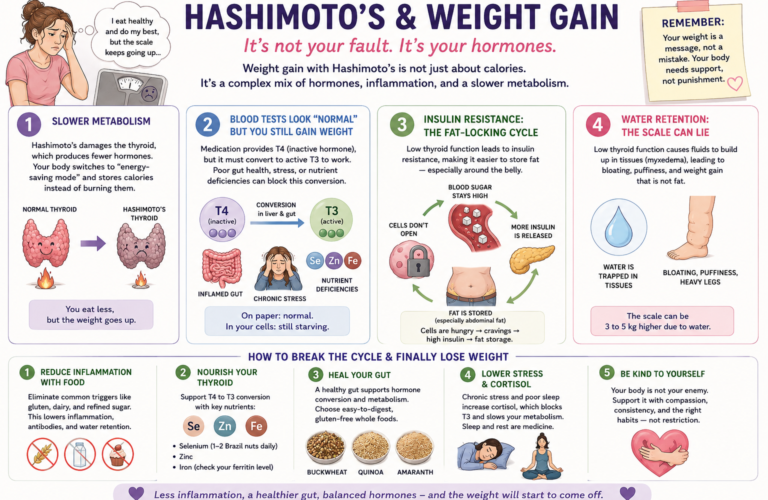
1. A Slower Metabolism
Think of your thyroid gland as the thermostat in your home. Its job is to determine how quickly your body burns fuel (the calories from food) to produce energy and heat.
With Hashimoto’s, your immune system mistakenly attacks your thyroid gland, gradually damaging it. As a result, the thyroid produces fewer hormones. When those hormone levels decline, your body’s thermostat switches into energy-saving mode.
Your body doesn’t know you’re trying to lose weight. Instead, it assumes food is scarce and begins conserving every calorie it can, storing it as body fat instead of burning it for energy.
The result? You eat very little, yet the weight keeps increasing.
2. Why Do My Blood Tests Look “Normal” While I Keep Gaining Weight?
This is one of the biggest frustrations for people living with Hashimoto’s.
Your doctor may tell you, “Your thyroid levels are normal. Your medication is working. You shouldn’t be gaining weight.”
Yet you continue to gain weight.
So what’s happening?
Most thyroid medications, such as levothyroxine, provide your body with a hormone called T4. However, T4 is essentially an inactive storage hormone. For your cells to actually use it, your body must convert T4 into the active hormone T3.
Most of this conversion takes place in the liver and the intestines.
If your gut is inflamed, you’re under chronic stress, or you’re deficient in important nutrients such as selenium, zinc, or iron, this conversion may not happen efficiently.
On paper, your thyroid hormone levels appear normal. But inside your cells, it’s a different story—they’re still “starving” because they aren’t getting enough active T3.
3. Hashimoto’s and Insulin Resistance: The Dangerous Duo That Locks Away Fat
Your thyroid gland and pancreas work closely together. When thyroid function slows down, it directly affects how your body responds to insulin, increasing the risk of insulin resistance.
Here’s a simple way to picture it:
Imagine insulin as a doorman carrying the key that unlocks your cells so glucose from food can enter and be used for energy.
With low levels of active thyroid hormone (T3), those cellular “doors” become difficult to open. Insulin keeps knocking, but the cells don’t respond properly.
As glucose remains in the bloodstream, your body releases even more insulin in an attempt to solve the problem.
Unfortunately, high insulin levels send another message:
Store fat—and don’t let it be burned.
This creates a vicious cycle:
- Your cells don’t receive enough energy.
- Your brain tells you to eat something sweet or rich in carbohydrates.
- Blood sugar rises.
- Insulin rises.
- The cells still resist insulin.
- Excess calories are stored as body fat, especially around the abdomen.
4. Water Retention: Why the Scale Can Be Off by 3–5 Kilograms
Do you sometimes wake up with a puffy face, swollen eyelids, or fingers so swollen you struggle to remove your rings?
That sudden weight gain isn’t always body fat.
Very often, it’s water retention.
When thyroid function slows down, special sugar-like compounds—particularly hyaluronic acid—begin accumulating between your cells.
These substances behave like incredibly powerful sponges, attracting and holding onto large amounts of water.
This condition, known medically as myxedema, is different from ordinary swelling.
If you press on the swollen area, it usually doesn’t leave a dent. Instead, the tissue feels firm, tight, and rubbery.
This gel-like fluid also compresses the lymphatic vessels, slowing lymphatic drainage. That’s why many people with Hashimoto’s experience heavy legs, puffiness, and a constant feeling of swelling.
How Can You Break the Cycle and Finally Start Losing Weight?
Now that you understand the problem isn’t simply calories—but hormones and inflammation—it becomes clear why crash diets and severe calorie restriction often make things worse.
Your body interprets extreme dieting as another threat and slows your metabolism even further.
Instead, focus on these strategies:
Reduce Inflammation Through Nutrition
Avoid foods that commonly irritate the gut and trigger immune activity.
Many people with Hashimoto’s notice significant improvements after eliminating gluten, dairy, and refined sugar. Reduced inflammation often leads to lower antibody levels, less water retention, and improved energy.
Give Your Thyroid the Nutrients It Needs
For T4 to convert into active T3, your body requires adequate amounts of:
- Selenium (1–2 Brazil nuts per day can be a natural source)
- Zinc
- Iron (checking your ferritin level is especially important, as low iron stores can impair thyroid function)
Support Your Gut
Since much of thyroid hormone conversion happens in the digestive system, gut health matters.
Choose foods that are easy to digest. Naturally gluten-free pseudograins such as buckwheat, quinoa, and amaranth provide fiber while being gentle on the digestive tract.
Lower Cortisol—Your Stress Hormone
Chronic stress and poor sleep increase cortisol production.
High cortisol levels interfere with T3 production and encourage the formation of reverse T3, an inactive form of thyroid hormone that further slows metabolism.
Quality sleep and proper recovery are not luxuries—they’re essential parts of healing.
Final Thoughts
Weight gain with Hashimoto’s thyroiditis is not simply a cosmetic issue—it’s your body’s way of asking for help.
It’s telling you that it’s inflamed, exhausted, and lacking the nutrients it needs to function properly.
When you stop punishing your body with restrictive diets and instead support it by reducing inflammation, healing your gut, managing stress, and restoring hormonal balance, healthy weight loss becomes much more achievable.
The goal isn’t to fight your body.
The goal is to work with it.
Medical Disclaimer
The information provided on this website is intended for educational and informational purposes only and should not be considered medical advice, diagnosis, or treatment.